
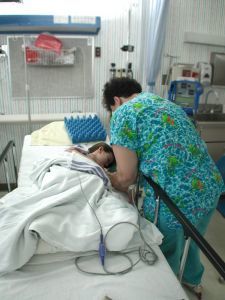
The first post in this series explored how invasive medical procedures can cause PTSD in children. The post listed four factors that increase the likelihood of PTSD developing. The factors are:
- Timing
- Anesthesia
- Age of patient
- Previous Trauma History
As promised in Part 1 of the series, this post will address the general principle behind the occurrence of PTSD and how it can be successfully treated.
General PTSD Principle
Linda Gantt, who spoke at the 2010 Linking PTSD and Medical Trauma national conference, said the risks of developing PTSD increase according to this general principle: The more unexpected the procedure, the younger the patient, the more numerous the previous traumas, and the more urgent the need for the procedure, the greater the possibility that there will be psychological effects.
No Wonder Our Son Had PTSD
When Dr. Gantt’s explained the four factors and the general principle behind them, the burden of guilt I carried about our son’s PTSD no longer weighed upon me. Our son’s medical treatment was completely unexpected, within 24 hours of his birth, and immediately necessary for him to live. With three of the four factors involved in his trauma, no wonder he developed PTSD. And since medically induced PTSD wasn’t even on the radar screen when he had surgery in 1982, no wonder it went undetected for so long.Prevent
How to Prevent PTSD
In 2010, the vast majority of kids can avoid developing medically induced PTSD. Depending on the age of the child and the circumnstances, it can be prevented by:
- having the hospital’s child life specialist help prepare your verbal child for scheduled medical procedures or surgeries.
- having the the child life specialist remediate trauma caused by an emergency medical procedure or surgery in a verbal child.
- having someone rub a pre-verbal child’s arm and talk quietly to him during procedures or surgeries.
- having soft music or a tape recording of the parent’s voice playing during procedures or surgeries.
How to Treat PTSD
Of course, not all PTSD can be prevented. But children can be successfully and easily treated for it. One great treatment resource is Peter Levine and Maggie Kline’s books, Trauma Through a Child’s Eyes: Awakening the Ordinary Miracle of Healing and Trauma-Proofing Your Kids: A Parents’ Guide for Instilling Confidence, Joy and Resilience.
If your child needs professional therapy, I highly recommend the Intensive Trauma Therapy Institute in Morgantown, West Virginia. You can learn more about their clinic at their website www.traumatherapy.com. If you know of other successful treatment centers, please leave a comment. I want every child with PTSD to receive treatment as quickly as possible!
Do you like what you see at DifferentDream.com? You can receive more great content by subscribing to the quarterly Different Dream newsletter and signing up for the daily RSS feed delivered to your email inbox. You can sign up for the first in the pop up box and the second at the bottom of this page.



Susan,
The pain of your early experiences comes through clearly in your comment. I am so sorry for what you’ve endured and are still enduring. Have you contacted the people at Intensive Trauma Therapy (ITT) before? If not, they may be able to help you. Their therapy is quite different from what you may have experienced, and they are very supportive. Please, contact them via the phone number at their website, http://www.traumatherapy.us.
Jolene
i read janets comments from 2011 and am so affected by her story. i am 62 and have had a lifetime of torment. unlike janet, i have been in therapy most of my life with small degree of help from many therapists over the years. i was finally diagnosed with complex, long term PTSD. as a child i had years of surgeries starting early for various things, mostly kidney disease which i was told would kill me. the procedures and treatment i received was cold and impatient, sometimes cruel. i had painful medical procedures every week for years. i have had severe lifetime disability from great fear of people. medical trauma was not the beginning nor the end of the harm done. both my parents were unable to do any “good parenting” even tho i frequently felt i was the center of their world and there to meet their every emotional need…or else . it was love. hate. love. hate. and i never knew which was coming. what is to be done for those of us who have such extreme damage to our identity and basic feeling of safety in our very bodies, as well as hearts and psyches? what will ever heal our mortal wounds?
Anete,
I am so sorry to hear about the negative impacts of your surgeries. I urge you to visit ITT’s website (http://www.traumatherapy.us/) to read more about their treatment. They could help you so much. Please use the contact page at this website if you are interested in talking about it privately.
Best wishes,
Jolene
Thank you for this!
I was born with multiple congenital abnormalities that required 14 years of surgery. The majority of the surgeries were in my pelvic area, including reconstruction of my anus and vaginal canal. The surgeries and interventions for these issues were frequent and lasted until my teenage years.
A bladder was removed, then my appendix and tonsils. My ears then needed tubes.
My earliest memories are of being in hospitals, in pain, confused, and not in control of my life. I grew up too fast by shouldering all those negative emotions and thoughts on my own and feeling as though nobody would care, since it seemed like nobody did unless it meant they got to cut into me.
This trauma has negatively impacted my life in every way possible. I’ve attempted suicide twice, been in and out of hospital for depression and anxiety, lack trust in people, and am unable to connect with others or situations. I’m so distant and have very little idea of who I am.
I’m glad to see that some attention is being paid to the psychological effects children go through when they undergo medical treatments. To a small person who is still trying to make sense of their world, it can be a confusing and frightening thing. Helplessness is a terrible thing to experience, especially when others aren’t aware of how distressing it is.
Deb,
Sorry this response is so late. Our son was treated at Intensive Trauma Therapy (ITT) in Morgantown, WV. In one week of 40 hours of out patient treatment, his life changed completely. Not only did they treat him, they taught him self-care techniques to help him recogonize when he’s sliding into a PTSD response and how to stop it. PTSD can be treated in weekly counseling sessions at other clinics, and that method requires much longer. I suggest you visit the ITT website at http://www.traumatherapy.us to read more about what they do and how to contact them.
If you have more questions, contact me through the form on the contact page of this website.
Jolene
Dear Tim,
Thank you for leaving your comment and for your advice to parents of kids going through surgery. I am so sorry for all you went through as a child and for the suffering you are still enduring. I’ll keep talking about PTSD in kids until mental health interventions exist to prevent such experiences for children now and in the future.
Jolene
I am 46 years old and was born with a cleft palate and heir lip.I had multiple surgeries to reconstruct my face. Since have had other severe trauma’s occur. I was only just diagnosed with severe PTSD,anxiety and depression and have started group counseling as well as indiv counseling. I always thought only veteran’s got PTSD from being in a war zone. Guess I was wrong.Does anyone know how long does it take to be healed from this?
Hello. I also have just come across this website. I am a father of two children living in the UK. I was born with a deformity of the genitals (hypospadias). It was very severe and required surgery to reconstruct. This surgery started when I was age 3 1/2 and continued for 13 years until the last operation at age 16, and required about 30 operations, plus numerous outpatient appointments, examinations etc. As an adult, I tried to commit suicide and am now on medication for mental health problems. I have now sourced some funded short term therapy (long term therapy for this is not available on the NHS in the UK)and have been researching trauma related problems, to help cope with the past and recent traumas. As a child, adolescent, and young adult I had no psychological support at all. I am glad that at last medical trauma is being highlighted – it has almost destroyed me. Parents if your child has hypospadias please be aware, if the surgery has to be repeated it can be very damaging to a child psychologically without clinical help and support.
You’re welcome, Amanda. You are not making much ado about nothing. Receiving treatment for PTSD and learning to cope with it’s after effects is life changing. That is huge! Best wishes to you.
Jolene
Just came across this site, and I am very grateful. I was diagnosed with a hip disease at age 4 and was put on crutches for two years. I was diagnosed w/ the same disease at age 11 and had to have surgery and bodycast to correct the problem. Subsequent hip problems led to 3 more surgeries, another bodycast, confinement to bed for 6 weeks and then a hip replacement. I never realized it was a TRAUMA and i had ptsd from it until a few years ago. I have been doing EMDR therapy for a little over a year and it is slowly healing me. I can remember certain things about my trauma, and there is no “charge”. A miracle. There are still a lot of layers to get through, but to know that the medical world is linking the two (ptsd & medical traume) is groundbreaking and extremely validating. Like most survivors, I sometimes think I am “making much ado about nothing” but this website tells me something different. thank you.
Dear Janet,
I’m so glad you found this site and pray that you find treatment and resolution for what you experienced in your childhood. Don’t wait until the 2011 ITT Conference, though. Please you to their website, http://www.traumatherapy.us and read about it. Then call them and talk to a therapist. They may have trained someone who lives in your area. Or, you may want complete their assessment forms. If they diagnose PTSD, I urge you to consider going to Morgantown for treatment when they have an opening.
If you would like to discuss this further, let me know and we’ll continue the dialogue via email.
Jolene
I came upon this website while researching this subject for my own personal understanding. I believe I have suffered from “medical PTSD” my entire life.It originated from molestation during repetitive treatments for kidney disease from the age of approx. 2 to the age of 8. Whether this molestation was intended or the procedure and a rough and uncaring physician made it feel that way may not be certain but the details are very clear to this day and there are certain words that still cause great distress and make my stomach turn over. The point is it does not matter because the end result and its effects were the same. The logical understanding has helped me identify the source of many of my feelings and behaviors but does does not eliminate the pain and the abnormal fears I still live with today. I am 61 years old. I hope this conference in 2012 will aggressively address a problem that is extremely debilitating for many.
Hi Wendy,
Their next conference will be in 2012, as they had one in 2011 and hold them every two years. Last year’s focused on medical trauma. You would have loved it. Do you have any kind of social work or medical background? They do trainings for professionals, and their methods are ground-breaking. The staff is approachable. I encourage you to call the clinic and ask to talk to Carrie Downey. Mention my name if you like.
Jolene
Hi Jolene,
It’s great that you are posting material about the connection between PTSD and infant/child medical trauma. Would you happen to know if ITT will be hosting a PTSD and Medical Trauma conference in 2011?
Hi Terry,
Yes, Linda said I might hear from you. I’m so glad ITT was able to help you, too. I will contact you via private email to talk more.
Jolene
Hi Jolene,
Linda Gantt told me about you being at the clinic with your son. Nothing of his history just that you were their key note speaker at their medical trauma conference.
I believe she called to ask if we could communicate and told you that I had expperienced infant surgery trauma and was diagnosed with PTSD. My experience at the clinic was remarkable. I have tried many things and think Linda and Lou really have the key to helping people make sense of their life again.
I am working on several ideas, including an article in regard to my experience. Do you know if your son had anesthesia during his multiple sugeries? I am guessing not since it was before 1986.
Please contact me on my email, I do not have yours, as I would be very interested in hearing from you.
Best, Terry Monell